
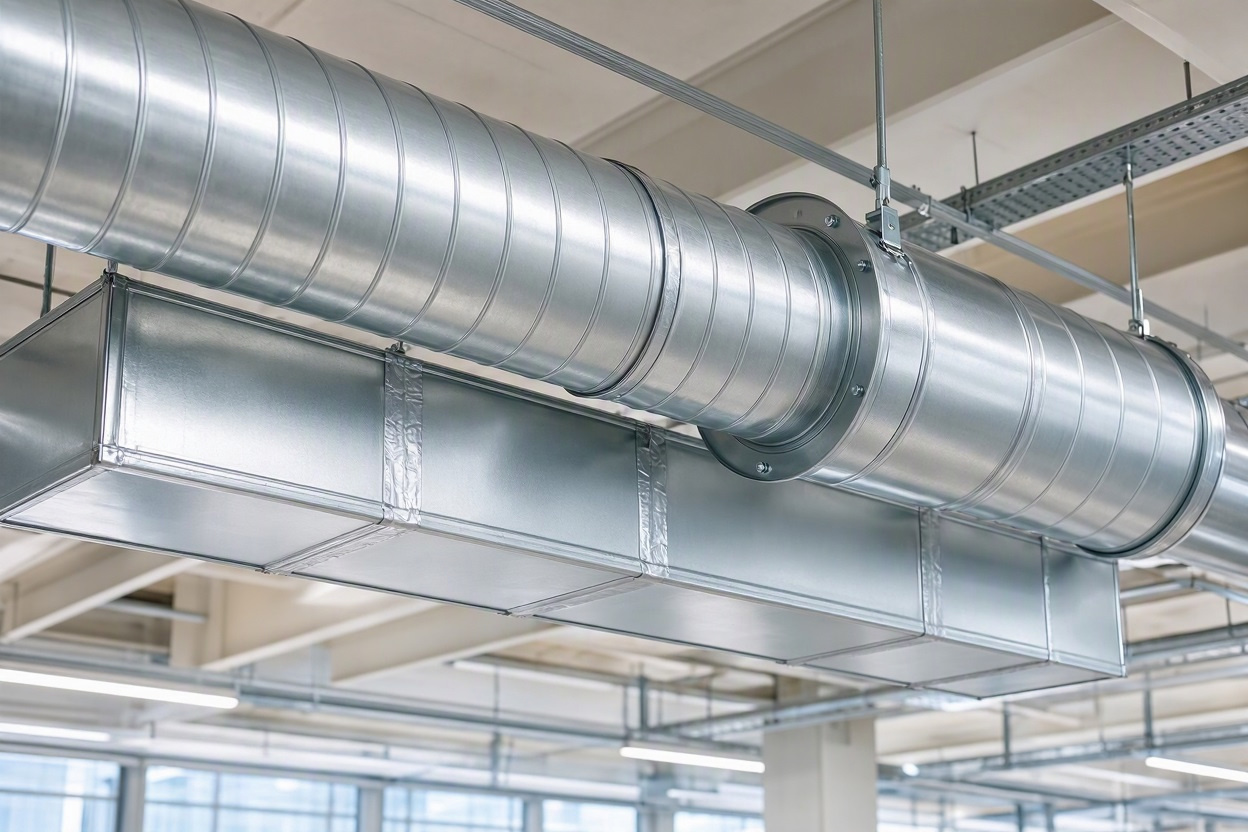
AC Duct Size Calculator
Enter your airflow and friction rate to get round and rectangular duct size, air velocity and pressure loss. Free, no signup.
Quick Answer
To size an AC duct, divide your airflow (CFM) by the target air velocity, or use the equal friction method: pick a friction rate, then find the diameter that carries your CFM at that rate. At 1000 CFM and 0.08 in. w.g. per 100 ft, this AC duct size calculator gives a 14.5 in round duct (next standard size 16 in) or an 18 x 10 in rectangular duct. Most comfort-cooling main ducts are checked against 700 to 1200 FPM. To find the CFM of an existing duct, multiply its area in square feet by the velocity in FPM (see the duct CFM formula below).
AC Duct Size Calculator
Enter airflow and friction rate, choose round or rectangular, then calculate.
How To Use The AC Duct Size Calculator
- Enter the airflow. Use CFM in imperial mode or L/s in metric mode. If you only know the tonnage, use about 400 CFM per ton from the AC Tonnage Calculator.
- Keep or change the friction rate. 0.08 in. w.g. per 100 ft (0.65 Pa/m) suits most comfort cooling jobs.
- Pick the shape. For a rectangular duct, enter one fixed side (the height). The tool solves the other side and warns you if the aspect ratio goes above 4 to 1.
You get the exact size, the next standard size, air velocity, pressure loss and a velocity check for a main or branch duct.
The Equal Friction Method
Equal friction is the most common way to size low-velocity supply and return ducts. You choose one friction rate and use it for every section, so the pressure drop per 100 ft stays the same from the fan to the last diffuser. This calculator uses the ASHRAE round-duct friction equation:
Round diameter D (in) = (0.109136 x CFM^1.9 / friction)^(1/5.02)
For rectangular ducts it uses the equivalent diameter formula, so a rectangle and a round duct of the same equivalent diameter have the same friction at the same airflow:
Velocity is simply airflow divided by the duct area in square feet. The results are for clean galvanized sheet metal duct at standard air. Flex duct, duct board and fittings add extra loss.
Duct CFM Formula: Find CFM from Duct Size and Velocity
Use this when the duct already exists and you want to know how much air it can carry. CFM is the duct area in square feet multiplied by the air velocity in feet per minute (FPM).
Round duct area (sq ft) = 3.1416 x (D / 12)^2 / 4, with D in inches
Rectangular duct area (sq ft) = Width x Height / 144, with sides in inches
Example 1 (round): a 12 in round duct has an area of 0.785 sq ft. At 900 FPM it carries 0.785 x 900 = 707 CFM.
Example 2 (rectangular): an 18 x 10 in duct has an area of 18 x 10 / 144 = 1.25 sq ft. At 800 FPM it carries 1.25 x 800 = 1000 CFM.
To get L/s, multiply CFM by 0.4719. Check the result against the velocity guide below, because a duct run too fast is noisy.
If you know the heat load instead, use CFM = BTU/hr / (1.08 x temperature difference in °F). For a 5 kW heater with a 20°F rise that is 5 x 3412.14 / (1.08 x 20) = about 790 CFM. The HVAC Unit Converter has the full kW to CFM formula. If you know the tonnage, use about 400 CFM per ton.
Round Duct CFM at Common Velocities
CFM = area x velocity. Values are rounded.
| Round duct | Area (sq ft) | CFM at 700 FPM | CFM at 900 FPM | CFM at 1100 FPM |
|---|---|---|---|---|
| 6 in | 0.196 | 137 | 177 | 216 |
| 8 in | 0.349 | 244 | 314 | 384 |
| 10 in | 0.545 | 382 | 491 | 600 |
| 12 in | 0.785 | 550 | 707 | 864 |
| 14 in | 1.069 | 748 | 962 | 1176 |
| 16 in | 1.396 | 977 | 1257 | 1536 |
| 18 in | 1.767 | 1237 | 1590 | 1944 |
| 20 in | 2.182 | 1527 | 1963 | 2400 |
Recommended Air Velocities
Common design guide for comfort cooling
| Duct type | Velocity (FPM) | Velocity (m/s) |
|---|---|---|
| Main duct | 700 to 1200 | 3.6 to 6.1 |
| Branch duct | 500 to 800 | 2.5 to 4.1 |
| Too low (oversized) | Below 500 | Below 2.5 |
| Too high (noisy) | Above 1200 | Above 6.1 |
Worked Example: 1000 CFM at 0.08 in. w.g. per 100 ft
- Round size: D = (0.109136 x 1000^1.9 / 0.08)^(1/5.02) = 14.5 in. The next standard size is 16 in.
- Check the 16 in duct: area = 1.40 sq ft, so velocity = 1000 / 1.40 = 716 FPM. Pressure loss drops to about 0.049 in. w.g. per 100 ft. This is a good main duct.
- Rectangular with a fixed 10 in height: the width that gives the same equivalent diameter is 18.1 in. Round up to a 19 x 10 in duct. Velocity is 758 FPM and the aspect ratio is 1.9 to 1.
If you must use the smaller 14 in round duct, velocity rises to 935 FPM and loss to 0.096 in. w.g. per 100 ft. It still works for a main duct, but it is noisier.
Round And Rectangular Duct With The Same Airflow
At 1000 CFM and 0.08 in. w.g. per 100 ft
AC Duct Size Calculator FAQ
For comfort cooling in homes and offices, 0.08 in. w.g. per 100 ft (about 0.65 Pa/m) is the most common design value. Low-noise spaces use 0.06 to 0.08. Short, simple runs can go up to 0.10.
Keep the same airflow and friction rate. Fix one side, then solve for the other side so the equivalent diameter matches the round duct. This calculator does that for you. Use the formula De = 1.3 x (a x b)^0.625 / (a + b)^0.25.
For main ducts in comfort systems, 700 to 1200 FPM (3.5 to 6 m/s) is a common target. For branch ducts, 500 to 800 FPM (2.5 to 4 m/s). Higher velocity means more noise and more fan energy.
Keep it at 4 to 1 or lower. A ratio near 1 to 1 or 2 to 1 is best. Very flat ducts have more surface area, so they lose more pressure and cost more.
Most DX cooling systems are designed for about 350 to 450 CFM per ton. A 3 ton unit at 400 CFM per ton needs about 1200 CFM. Use the AC Tonnage Calculator first, then size the duct from the CFM.
Multiply the duct area in square feet by the air velocity in FPM. For a round duct, area = 3.1416 x (D / 12)^2 / 4 with D in inches. Example: a 12 in duct at 900 FPM carries 0.785 x 900 = about 707 CFM.
About 550 CFM at 700 FPM, 707 CFM at 900 FPM and 864 CFM at 1100 FPM. For quiet comfort cooling, stay near the lower end of that range.
Use CFM = BTU/hr / (1.08 x temperature difference in °F). To start from kW, multiply by 3412.14 first. Example: 5 kW with a 20°F rise is 17,060.7 BTU/hr, which gives about 790 CFM.
No. It gives a good estimate for planning and checking. The final design must follow your local code and the ASHRAE and SMACNA guidance for your project, including fittings, duct material and roughness.
Important Note
This tool gives estimates for planning and quick checks. It does not replace a full duct design. Final sizing must follow your local building code and the guidance in the ASHRAE Handbook and SMACNA duct construction standards. Fittings, flex duct, duct leakage and altitude can change the real pressure loss.