This free Motor Belt Pulley Bearing Calculator gives HVAC technicians instant belt length, pulley ratio, fan RPM, and bearing-size results, right in the browser — no sign-up, no app download.
Motor, Belt, Pulley aur Bearing Calculator
HVAC technicians ke liye — sahi belt size, pulley ratio, aur bearing number turant nikalein. No sign-up, no app download, seedha browser mein calculate karein.
| Bearing No. | Series | Bore (mm) | OD (mm) | Width (mm) |
|---|
| Motor HP | Typical Pulley Size Range | Typical Belt Type | Typical Bearing Size |
|---|
Belt Tension Check (Deflection Method)
Belt ke span ke beech mein hath se halka force lagakar deflection check karein. Standard rule: har 1 inch (25.4mm) span length ke liye lagbhag 1/64 inch (0.4mm) deflection normal hai.
Bearing Numbering System
Example: 6 2 05 — pehla digit series type (6 = deep groove ball bearing), doosra digit dimension series (0/2/3 = light/medium load), aakhri do digits bore code (× 5 = bore in mm; 00=10, 01=12, 02=15, 03=17mm).
Table of Contents
How This Motor Belt Pulley Bearing Calculator Works
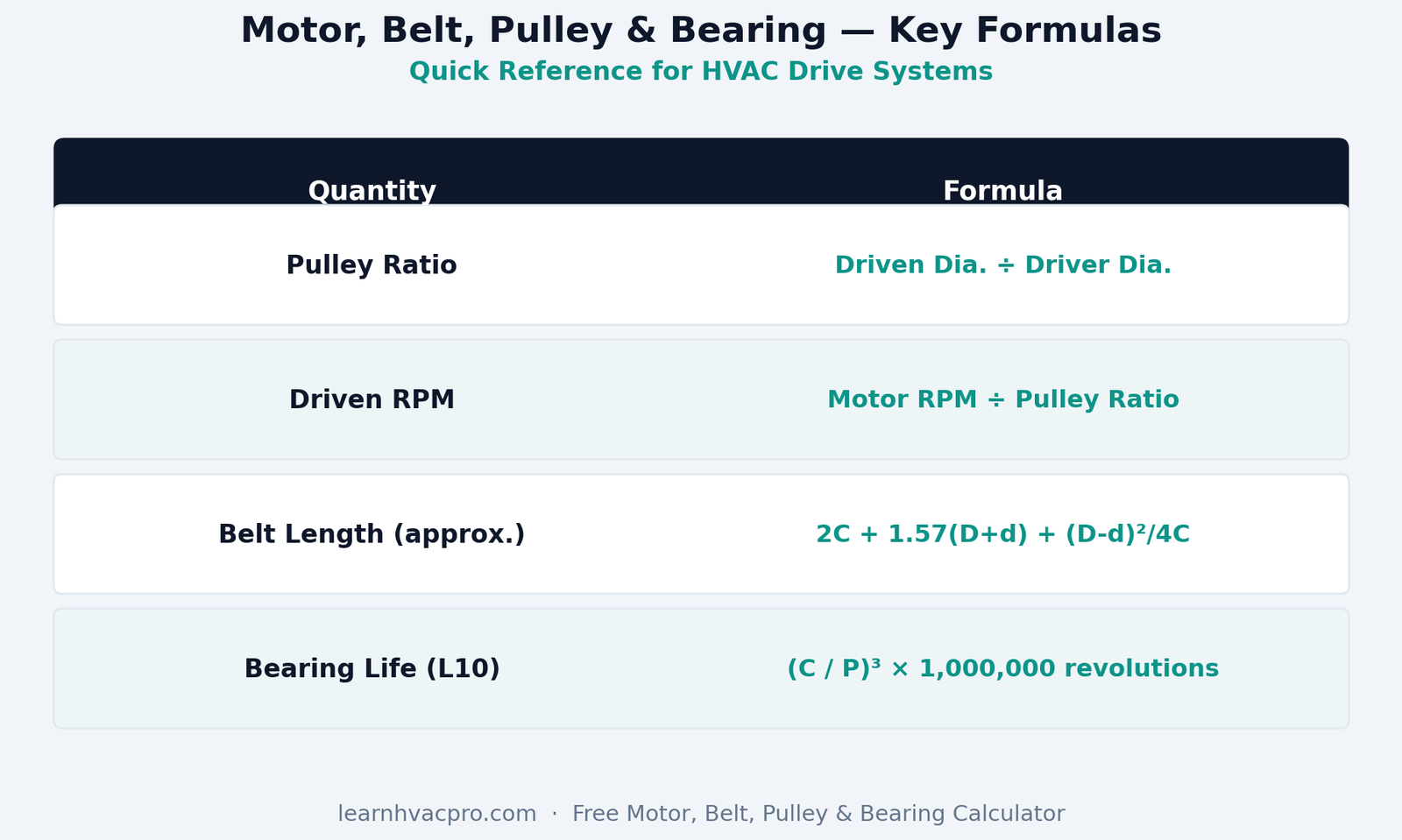
This Motor Belt Pulley Bearing Calculator helps HVAC technicians quickly work out drive-system numbers on the job: pulley ratio, driven-shaft RPM, belt length, and bearing life expectancy. These are the same calculations used when replacing a blower motor, resizing a pulley, or troubleshooting an AHU or cooling-tower fan that isn’t turning at the right speed.
For the underlying bearing-life (L10) standard used by manufacturers, see ISO 281 — Rolling Bearings Life Rating. Getting pulley ratios right matters especially in Gulf-region HVAC work, where AHU and cooling-tower fans run long hours in high ambient heat — an incorrect ratio means the motor works harder than it should, shortening bearing and belt life.
Frequently Asked Questions
How do I calculate pulley ratio for a motor?
Divide the driven pulley diameter by the driver (motor) pulley diameter. This Motor Belt Pulley Bearing Calculator does this instantly and also gives you the resulting driven RPM.
How do I estimate bearing life?
Bearing life (L10) is estimated using the dynamic load rating (C) divided by the actual load (P), cubed, multiplied by one million revolutions. Enter your bearing’s C and P values above for an instant estimate.
Why does correct pulley sizing matter for HVAC motors?
Wrong pulley ratios push the motor and bearings to run outside their design speed, causing premature belt wear, excess vibration, and shortened motor and bearing life — especially in continuously-running Gulf-climate HVAC systems.
More Free HVAC Tools
- AC Tonnage Calculator — find the right AC size for your room
- HVAC Unit Converter — BTU, Ton, kW, PSI, CFM & more
- Electricity Cost Calculator — estimate your AC’s monthly running cost
- Superheat & Subcooling Calculator — for refrigerant charging checks
- About Learn HVAC Pro — 10 years of real Gulf-region HVAC field experience