
All HVAC Unit Converters — In One Place
Instantly convert BTU, Ton, kW, PSI, CFM, and more — built for HVAC professionals
100% Free · Instant ResultsFormulas are standard HVAC engineering conversions. Type in either box — results update live, no calculate button needed.
HVAC Unit Converter — Key Formulas
This HVAC unit converter handles the most common conversions technicians need on the job: BTU/hr to Tons, Tons to kW, PSI to Bar, and CFM to m³/h. One ton of refrigeration equals 12,000 BTU/hr, which equals approximately 3.517 kW. These conversions follow standard ASHRAE engineering definitions, so results match what’s printed on equipment nameplates and manufacturer datasheets.
Important: cooling capacity in kW is not the same as electrical input in kW
This is the single most common mistake made when reading HVAC nameplates. When this converter turns 1 Ton into 3.517 kW, that figure is cooling capacity — the amount of heat the unit removes from the space. It is not the electrical power the unit draws from the supply.
The electrical input is always much lower, because an air conditioner moves heat rather than creating it. The relationship between the two is the efficiency rating: COP (Coefficient of Performance) or EER (Energy Efficiency Ratio). Electrical input kW = cooling capacity kW ÷ COP. So a 1 Ton unit (3.517 kW cooling) running at a COP of 3.0 draws roughly 1.17 kW of electrical power, not 3.517 kW. If you are sizing a breaker, a cable, or a generator, always use the electrical input figure from the nameplate — never the cooling capacity from this converter.
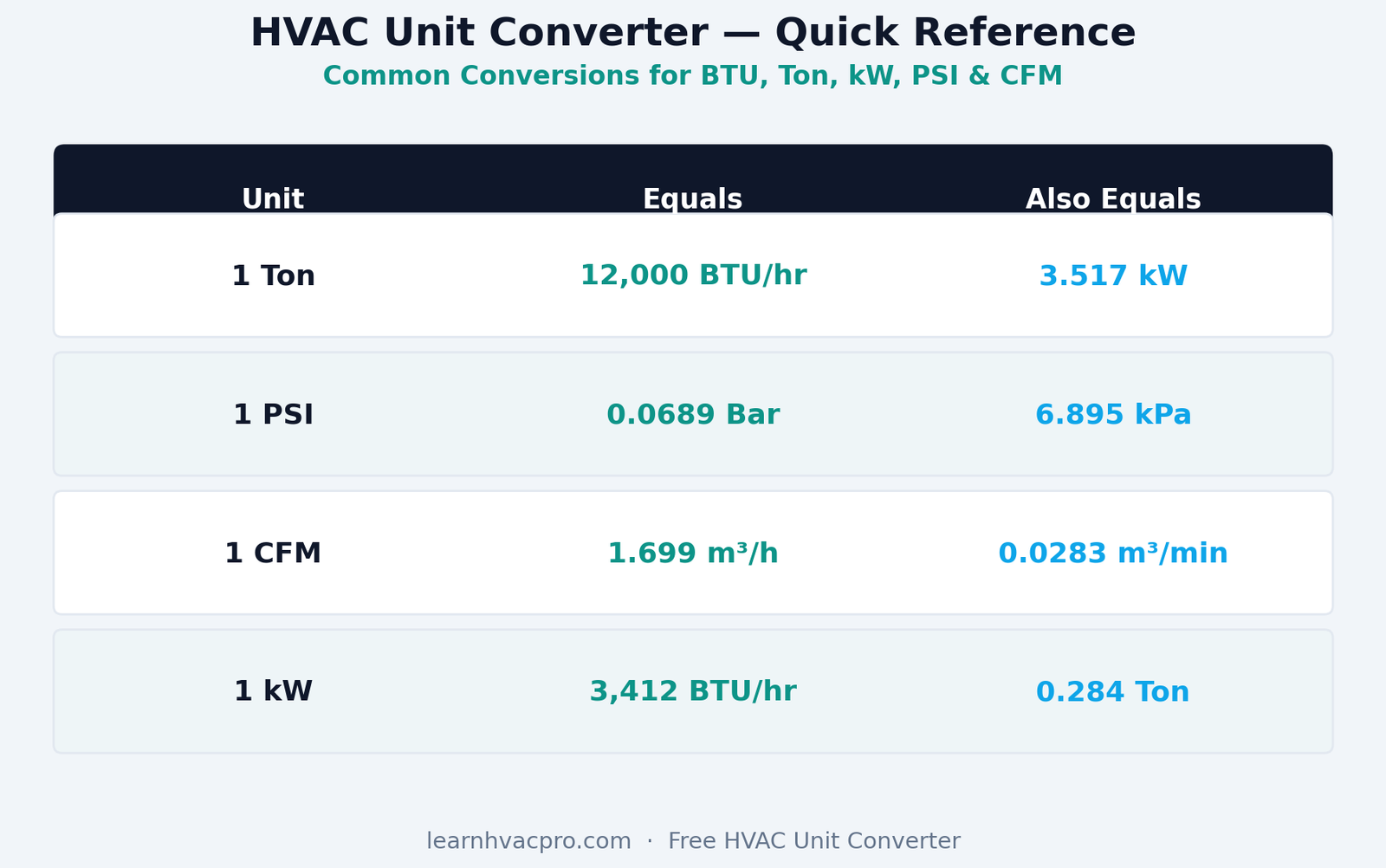
This HVAC Unit Converter is especially useful when you’re switching between equipment made for different markets. A US-manufactured chiller nameplate will usually list capacity in Tons and pressure in PSI, while a European or Asian unit lists the same specs in kW and Bar. Instead of doing the math by hand on-site, technicians in the UAE and wider Gulf region use this converter to cross-check readings instantly, whether they’re commissioning new equipment, comparing spec sheets, or troubleshooting a system with mixed imperial and metric components.
Table of Contents
For the official unit definitions behind these conversions, see NIST’s reference on SI energy units. Field technicians in the UAE and Gulf region often need to switch between imperial (BTU, Ton, PSI) and metric (kW, Bar, m³/h) units depending on whether equipment is US-made or European/Asian-made — this converter handles both directions instantly.
kW to CFM Formula
kW and CFM measure different things, so there is no single fixed conversion. kW is power (heat), CFM is airflow. To convert kW to CFM you also need the air temperature difference (ΔT) across the coil or heater. For standard air, the sensible heat equation is: BTU/hr = 1.08 × CFM × ΔT (in °F).
Short form: CFM = kW × 3,159 ÷ ΔT°F
If ΔT is in °C: CFM = kW × 1,755 ÷ ΔT°C
Steps: (1) multiply kW by 3,412.14 to get BTU/hr; (2) multiply the temperature difference in °F by 1.08; (3) divide the BTU/hr by that number. The factor 1.08 is for standard air (0.075 lb/ft³ density, 0.24 BTU/lb·°F specific heat, 60 minutes per hour). In hot or high-altitude conditions the air is less dense, so the real airflow needed is slightly higher.
Example 1: A 5 kW electric heater raises the air temperature by 20°F. BTU/hr = 5 × 3,412.14 = 17,060.7. CFM = 17,060.7 ÷ (1.08 × 20) = 17,060.7 ÷ 21.6 = about 790 CFM.
Example 2: A 1 ton cooling coil has a sensible capacity of 3.517 kW (12,000 BTU/hr) if all of it is sensible heat, and the air cools by 20°F. CFM = 12,000 ÷ (1.08 × 20) = about 556 CFM. Real coils also remove moisture (latent heat), so the sensible part is lower and the airflow per ton used in practice is usually around 350 to 450 CFM.
| Power | CFM at 15°F | CFM at 20°F | CFM at 25°F | CFM at 30°F |
|---|---|---|---|---|
| 1 kW | 211 | 158 | 126 | 105 |
| 2 kW | 421 | 316 | 253 | 211 |
| 3 kW | 632 | 474 | 379 | 316 |
| 5 kW | 1053 | 790 | 632 | 527 |
| 7.5 kW | 1580 | 1185 | 948 | 790 |
| 10 kW | 2106 | 1580 | 1264 | 1053 |
| 15 kW | 3159 | 2370 | 1896 | 1580 |
Values are rounded and use standard air. Use kW of heat (electric heater element power, or cooling capacity in kW), not the electrical input of an air conditioner. To get BTU/hr or tons from kW first, use the converter above.
Frequently Asked Questions
How many BTU are in 1 ton of AC?
1 ton of air conditioning equals 12,000 BTU per hour. This is the standard HVAC industry conversion used worldwide.
How do I convert PSI to Bar for refrigerant pressure?
Divide PSI by 14.5 to get Bar (1 Bar = 14.5 PSI). Use the HVAC Unit Converter above to convert refrigerant gauge readings instantly between PSI, Bar, and kPa.
What is CFM and how does it relate to airflow sizing?
CFM (Cubic Feet per Minute) measures airflow volume. It’s used to size ductwork and check ventilation rates. 1 CFM equals approximately 1.699 m³/h, which this converter calculates automatically.
How do I convert kW to CFM?
Use CFM = kW × 3,412.14 ÷ (1.08 × ΔT in °F). You need the air temperature difference. Example: 5 kW with a 20°F rise gives about 790 CFM.
Why do HVAC conversions matter in the Gulf region?
Most HVAC equipment sold in the UAE and wider Gulf region is imported — some from the US, where nameplates use BTU, Ton, and PSI, and some from Europe or Asia, where the same equipment is rated in kW, Bar, and m³/h. A technician quoting a job, ordering a replacement compressor, or checking a chiller’s rated capacity against site requirements needs to move between these two systems constantly.
Getting a conversion wrong by even a small margin can lead to an undersized or oversized unit being ordered, wasted budget, and a callback to fix the mistake. This HVAC Unit Converter removes that risk by giving instant, ASHRAE-standard results for every common HVAC unit pair, so field decisions are based on accurate numbers rather than rough mental math.
More Free HVAC Tools
- AC Tonnage Calculator — find the right AC size for your room
- Electricity Cost Calculator — estimate your AC’s monthly running cost
- Superheat & Subcooling Calculator — for refrigerant charging checks
- Motor, Belt, Pulley & Bearing Calculator
- AC Capacitor Calculator — test run capacitors and check MFD tolerance
- AC Duct Size Calculator — size round and rectangular ducts from your CFM
- HVAC Technician Interview Questions & Answers (Part 1) — includes BTU, Ton and unit-conversion questions from real UAE written tests
- About Learn HVAC Pro — 10 years of real Gulf-region HVAC field experience