
Refrigerant Superheat & Subcooling Calculator
This free superheat calculator checks your refrigerant charge instantly — accurate diagnosis, actionable advice
Enter Charge Details
Select your refrigerant and enter your gauge readings
📊 P/T Reference Chart
Full pressure-temperature chart for the selected refrigerant
Where To Measure?
Measurement points shown on a simple system sketch
Understand the Basics
Superheat is the extra heat a refrigerant vapor gains in the suction line after fully evaporating in the evaporator. It confirms all liquid has boiled off before reaching the compressor — protecting it from liquid slugging damage.
Subcooling is how much cooler the liquid refrigerant is than its saturation temperature after leaving the condenser. It confirms solid liquid (no vapor bubbles) is reaching the metering device for efficient system operation.
❓ Superheat Calculator FAQs
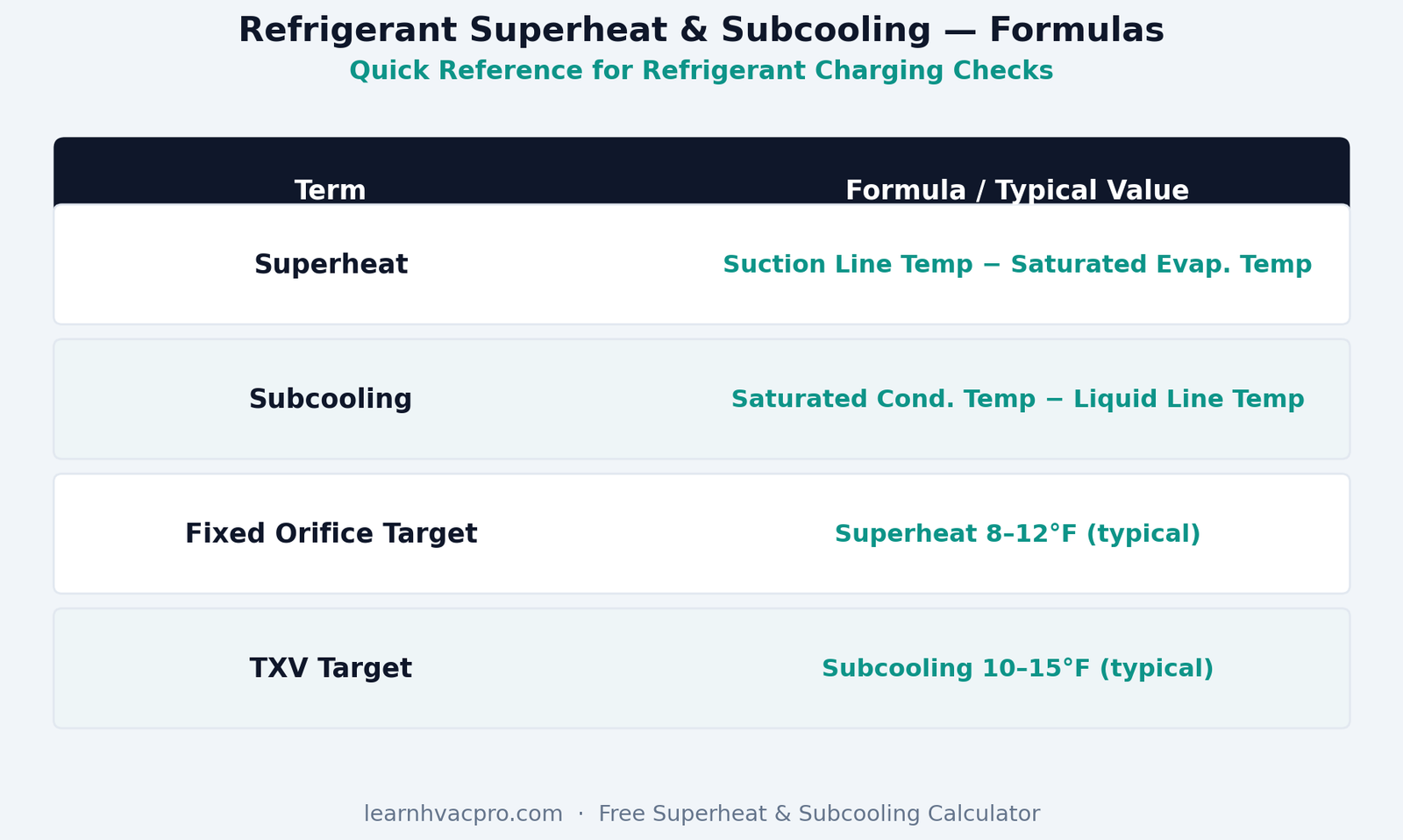
This superheat calculator compares your gauge suction pressure and suction line temperature against the refrigerant’s pressure-temperature chart. Formula: Superheat = Actual Suction Line Temperature − Saturated Evaporator Temperature (derived from pressure).
Subcooling = Saturated Condensing Temperature (from liquid pressure) − Actual Liquid Line Temperature. This superheat calculator applies both formulas automatically once you enter your readings.
HVAC technicians, AC mechanics, and field service engineers working on split AC, ducted AC, or commercial refrigeration systems in the Gulf can use this superheat calculator for instant charge diagnosis — without manually searching P/T charts.
You should check superheat and subcooling during new system commissioning, before and after adding or removing refrigerant charge, and whenever a system isn’t cooling properly.
Yes — this superheat calculator works for R-410A, R-32, R-22, R-134a, R-404A, R-407C, R-290, R-600a, R-448A, R-449A, R-1234yf and R-508B, and automatically handles the liquid/vapor split for glide-type refrigerants like R-407C.
Read more about the technical fundamentals of superheat and subcooling in this guide from ACHR News.
Table of Contents
Superheat Formula
Superheat shows how many degrees the refrigerant vapor is above its boiling point on the low side. To find it by hand:
- Read the suction (low-side) pressure from your gauge.
- Find the saturation temperature for that pressure on the pressure-temperature chart of your refrigerant.
- Measure the suction line temperature on the pipe near the outdoor unit service valve, with the probe insulated from the air.
- Subtract the saturation temperature from the suction line temperature.
Example 1 (R-410A): suction pressure 118 psig. The saturation temperature at 118 psig is 40°F. The suction line reads 52°F. Superheat = 52 – 40 = 12°F.
Example 2 (R-404A): suction pressure 54.5 psig. The saturation temperature at 54.5 psig is 20°F. The suction line reads 30°F. Superheat = 30 – 20 = 10°F.
The superheat calculator above does the chart lookup for you. It also accepts bar and °C if your gauges use those units.
Subcooling Formula
Subcooling shows how many degrees the liquid refrigerant is below its condensing point on the high side. Read the liquid (high-side) pressure, find its saturation temperature on the chart, measure the liquid line temperature near the condenser outlet, and subtract.
Example 1 (R-410A): liquid pressure 340 psig. The saturation temperature at 340 psig is 105°F. The liquid line reads 95°F. Subcooling = 105 – 95 = 10°F.
Example 2 (R-404A): liquid pressure 234 psig. The saturation temperature at 234 psig is 100°F. The liquid line reads 90°F. Subcooling = 100 – 90 = 10°F.
How the Calculator Rates Your Result
After you enter your readings, the superheat calculator marks each result as low, normal or high using these general ranges:
| Reading | Low | Normal range | High |
|---|---|---|---|
| Superheat | Below 5°F | 5°F to 20°F | Above 20°F |
| Subcooling | Below 8°F | 8°F to 15°F | Above 15°F |
These are general ranges only. On a fixed-orifice system, use the target superheat formula below. On a TXV or EEV system, charge to the subcooling target on the nameplate or in the installation manual.
Pressure and Temperature Chart for Common Refrigerants
This chart lists the pressure in psig at each saturation temperature. It uses the same data as the superheat calculator, so you can check a reading by hand. For glide refrigerants such as R-407C, use the calculator, because it handles the liquid and vapor values separately.
| Saturation temp | R-410A | R-32 | R-22 | R-134a | R-404A |
|---|---|---|---|---|---|
| 30°F | 96.8 | 99.1 | 54.9 | 26.1 | 68.4 |
| 35°F | 107 | 109.7 | 61.5 | 30.4 | 76.1 |
| 40°F | 118 | 121 | 68.5 | 35 | 84.4 |
| 45°F | 130 | 133 | 76 | 40.1 | 93.2 |
| 50°F | 142 | 145.9 | 84 | 45.5 | 103 |
| 90°F | 274 | 281.3 | 168 | 104 | 202 |
| 95°F | 295 | 302.9 | 182 | 114 | 218 |
| 100°F | 317 | 325.7 | 196 | 124 | 234 |
| 105°F | 340 | 349.6 | 211 | 135 | 252 |
| 110°F | 365 | 374.9 | 226 | 147 | 270 |
| 115°F | 391 | 401.4 | 243 | 159 | 289 |
| 120°F | 418 | 429.3 | 260 | 171 | 310 |
| 125°F | 446 | 458.6 | 278 | 185 | 331 |
Pressure in psig. Low-side readings usually fall in the 30°F to 50°F rows, and high-side readings in the 90°F to 125°F rows.
Target Superheat for Fixed-Orifice (Piston) Systems
The superheat calculator above tells you the actual superheat on the system. But on a fixed-orifice (piston or capillary) system, there is no single “correct” superheat number — the right value changes with indoor humidity and outdoor temperature. To know whether the reading is good, compare it against a target superheat worked out from the conditions on the day.
The standard field formula used in HVAC training is:
Target Superheat (°F) = (3 × Indoor Wet-Bulb °F − 80 − Outdoor Dry-Bulb °F) ÷ 2
Measure indoor wet-bulb at the return air near the evaporator, and outdoor dry-bulb at the condenser air inlet, shaded from direct sun.
Worked examples
- Indoor wet-bulb 63°F, outdoor dry-bulb 95°F: (3 × 63 − 80 − 95) ÷ 2 = (189 − 80 − 95) ÷ 2 = 7°F target superheat.
- Indoor wet-bulb 67°F, outdoor dry-bulb 85°F: (3 × 67 − 80 − 85) ÷ 2 = (201 − 80 − 85) ÷ 2 = 18°F target superheat.
If your measured superheat is well above the target, the system is usually undercharged; well below the target usually means overcharged or low airflow. If the formula gives a result below about 5°F, conditions are outside the range where this method is reliable — check airflow and filters first before touching the charge.
TXV and EEV systems: charge by subcooling, not superheat
This target-superheat formula is only for fixed-orifice systems. On a system with a TXV (thermostatic expansion valve) or EEV (electronic expansion valve), the valve itself controls superheat, so superheat stays roughly constant whatever the charge. On those systems, charge by subcooling instead, and use the target subcooling printed on the outdoor unit’s nameplate or in the manufacturer’s installation manual. The subcooling reading from the calculator above is the number to compare.
More Superheat and Subcooling Questions
What is the superheat formula?
Superheat = suction line temperature – saturation temperature at the suction pressure. Example: R-410A at 118 psig has a saturation temperature of 40°F. With a suction line temperature of 52°F, the superheat is 12°F.
How do I calculate superheat for R-404A?
Use the same formula with the R-404A pressure-temperature chart. Example: R-404A at 54.5 psig has a saturation temperature of 20°F. With a suction line temperature of 30°F, the superheat is 10°F. In the calculator, choose R-404A, then enter your pressure and temperature readings.
How do I calculate subcooling for R-410A?
Subcooling = saturation temperature at the liquid pressure – liquid line temperature. Example: R-410A at 340 psig has a saturation temperature of 105°F. With a liquid line temperature of 95°F, the subcooling is 10°F.
What is the difference between superheat and subcooling?
Superheat is measured on the low side (suction line) and shows how many degrees the vapor is above its boiling point, so it shows that no liquid is returning to the compressor. Subcooling is measured on the high side (liquid line) and shows how many degrees the liquid is below its condensing point, so it shows that the liquid line is full of liquid.
What is a good superheat reading?
There is no single number. On a fixed-orifice system, compare your reading with the target superheat formula on this page. On a TXV or EEV system the valve controls superheat, so charge by subcooling using the target on the nameplate. This calculator flags superheat below 5°F as low and above 20°F as high, and subcooling below 8°F as low and above 15°F as high, as a general guide only.
More Free HVAC Tools
- AC Tonnage Calculator — find the right AC size for your room
- HVAC Unit Converter — BTU, Ton, kW, PSI, CFM & more
- Electricity Cost Calculator — estimate your AC’s monthly running cost
- Motor, Belt, Pulley & Bearing Calculator
- AC Capacitor Calculator — test run capacitors and check MFD tolerance
- AC Duct Size Calculator — size round and rectangular ducts from your CFM
- HVAC Technician Interview Questions & Answers (Part 1) — includes a superheat and liquid slugging question from real UAE written tests
- About Learn HVAC Pro — 10 years of real Gulf-region HVAC field experience